The IEEPA Tariffs: An Incompetent Supreme Court Tries to put Humpty-Dumpty Together Again
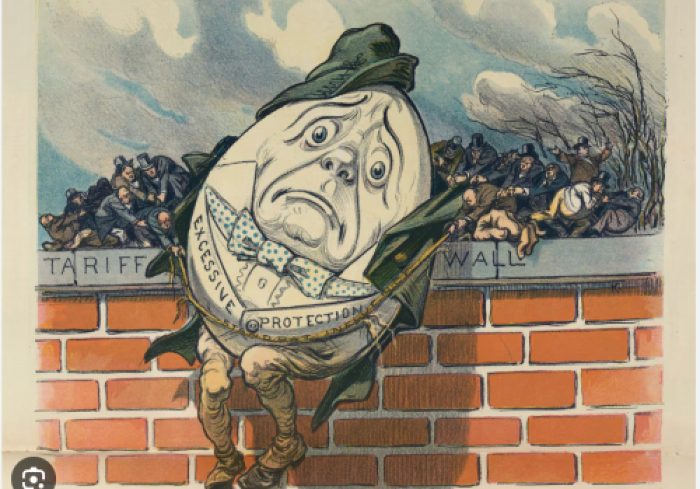
On Friday February 20, 2026, the Supreme Court of the United States at long last found that the President's use of the emergency national security powers of the IEEPA law were improperly conceived as a tool of economic policy (I would say coercion). It formed a coda to the April 2, 2025 "Liberation Day" where the President theatrically announced a stream of tariffs against nations across the world. The stock markets gyrated immediately. Economists scoured the tariff schedules, determining the President's staff used bizarre "napkin-math" calculations to tabulate the tariff rates. Due to some kind of "Excel spreadsheet merge" and rank incompetence, the United States even announced tariffs on an island whose only inhabitants were penguins.
As with all actions of the Trump administration, the tariffs were equal measures absurdist and comical, ruthless and ridiculous. Trump's view of tariffs formed decades ago in the 1980s, when the United States was fiercely fighting against Japanese exporters in the automotive and electronics industry. During that time, trade protectionists in the Congress would smash up Toshiba and JVC products the way current representatives shoot climate legislation with rifles. Honda, Nissan and Toyota were making deep inroads into the U.S. car market. Trump was no doubt deeply suspicious of the Japanese, who at that time occupied space in the national consciousness that we associate with China today. Trump would speak of the need for the United States to slap tariffs on the Japanese because his understanding of the tool is that it operates as a sort of "economic headlock or suplex" that a powerful nation applies as an act of pure brutal domination.
Trump has never really understood the economic underpinnings of tariffs. How tariffs affect import-export balances. How interconnected supply chains operate. How distributed manufacturing and specialization has changed the structure of industrial output. Some commentators ascribe too much intellectualism to him. They will say he wants to take America back to the late 1890s and to the Smoot-Hawley Act which raised tariff barriers in an "American First" environment of pre-war rivalry with other nations. Suddenly they discuss tariff policies that he wouldn't have the foggiest clue about. Trump isn't that much of a strategic thinker. He simply sees tariffs as a means to squeeze blood from a rock. You strong-arm your counterparty with brutish nastiness.
This is all to say that it was unsurprising that Trump would embark on the sweeping tariff regime he unleashed in the Spring 2025. He has never been subtle that he sees the globe as a series of bilateral show-downs in which his goal is to enact "lose-lose" consequences on both the United States and its adversary (or ally). In Trump's framework, the only time America ever wins is when he personally wins. This is why he made negotiations on tariffs a highly character-driven, deeply unprofessional interaction. Often springing trade terms on his partners in meet-and-greet photo ops with the press. The Swiss were able to remove capricious tariffs on their exports by bringing him a fancy Rolex desk clock. Other nations sought abeyance of his tariffs with flattery, theatrics, personal gifts, and of course the shadow deals carried out in crypto with The Trump Organization, his eponymous empire of fraud run by his two corrupt sons.
The Supreme Court of the United States was well aware of all of Trump's tricks and schemes when a lower court enjoined enactment of the tariffs pending a review of the Constitution basis for issuing them. The role of the courts in this instance was clear and unequivocal. If we did not know whether the President of the United States was appropriately applying the powers of the Executive Branch to tariffs, then the Judicial Branch had an obligation to honor the injunction until a the highest court in the land either blessed the President's interpretation of his tariff authority or ruled it impermissible. The appropriate principle at play was first do no harm.
Enjoining Trump's tariffs in April would not have brought the country to its knees. It merely would have deprived the President of a arbitrary and legally dubious tool until the Supreme Court expressly drew the lines for Constitutional authority. This is what we want a highest court to do. It would not have cratered our economy. It would not have destroyed the country. These were the shrill and hyperbolic pronouncements of the president himself. What would have happened is tens of thousands of businesses and major corporations would have proceeded to conduct economic affairs in a predictable market. Instead, by allowing the President to wield a capricious and ultimately illegal power for nearly a year, the Supreme Court introduced tremendous uncertainty into the economy and international affairs. Every morning the world woke up to find some middle of the night decision on tariff policy. Individual stocks soared or plummeted in response depending on their products or markets. A casual friend of Trump on Monday was a fierce enemy on Wednesday and a close bosom-buddy by Friday.
President Trump would announce a tariff rate. A country's highest representative might call a meeting. The tariff would be lifted. Then he would apply it again. Then he would lift it. Then he would lower it. Then he would raise it. Ultimately, the President was so out-of-control in his use of the tariff authority that "outright corruption and market manipulation" became a plausible explanation for the tariff rate. "Call up Eric Trump, transfer the crypto payment, get your tariffs lifted" was as good an explanation for his economic policy as any other. None of this would have been possible without the Supreme Court dissolving the lower court injunction allowing him to exercise IEEPA tariff authority.
In his opinion for the majority, Chief Justice John Roberts wrote the following gob-smacking statement:
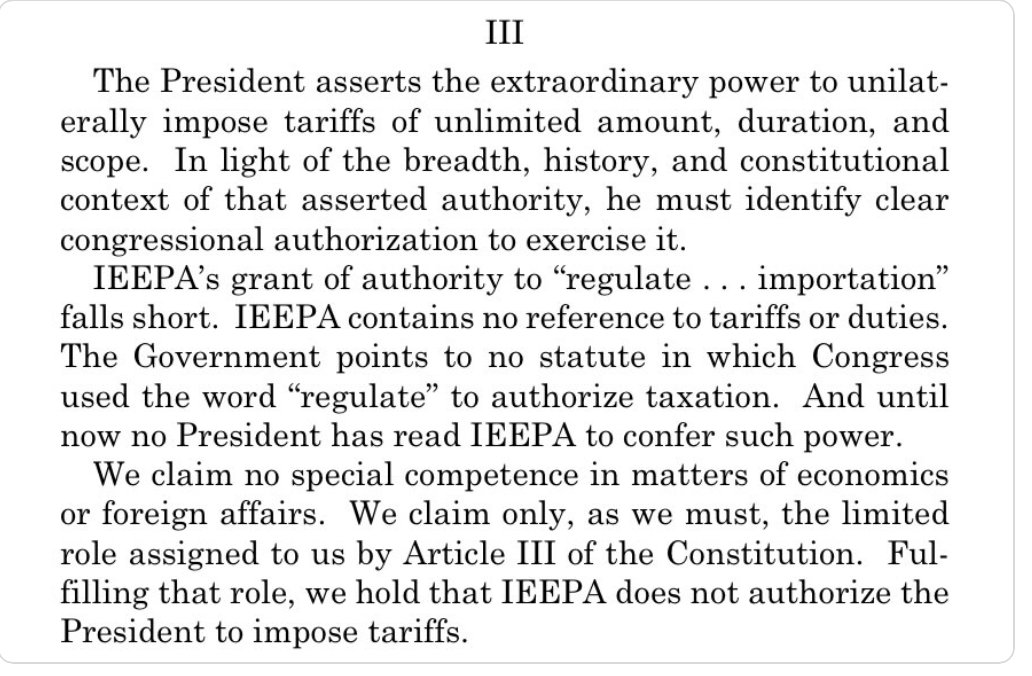
We claim no special competence in matters of economics or foreign affairs? I almost punched a wall. Yes! That's why you should have left the injunction in place! You are not experts in tariff policy and you let the President of the United States exercise unconstitutional authority for nearly a year. Dissolving the injunction was the opposite of judicial deference. The injunction on the IEEPA tariffs preserved a status quo ex ante where the President could not willy-nilly apply tariffs like he was ordering off a Denny's menu. It would have kept the county on an economic policy track that was consistent for decades. Instead, John Roberts purports to say that all he's ever done is perform "the limited role assigned to us by Article III of the Constitution." He could not have done something less restrained than dissolving this initial injuction.
For his part, the preening, obnoxious self-absorbed (and intelligent) Associate Justice Neil Gorsuch provided his own lengthy lecture on the important role of the legislative branch in exercising tariff authority. He wasn't wrong! Gorsuch wrote the following Schoolhouse Rock wikipedia page:
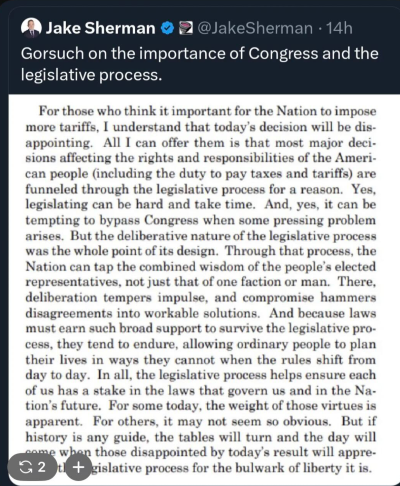
Gorsuch says "And yes it can be tempting to bypass Congress when some pressing problem arises. But the deliberative nature of the legislative process was the whole point of its design. Through that process, the Nation can tap the combined wisdom of the people's elected representatives, not just that of one faction or man." Well, nicely put Justice Gorsuch. Then why did you dissolve the injunction? Why would you think this and then give one man the power? If anything this sentiment from Justice Gorsuch indicts him for his carelessness so many months earlier.
The Roberts Court is always up to these tricks. They drag out the litigation timelines, dissolve injunctions, use the shadow docket, and let President Trump run wild trampling the Constitution for months or years. Then, after all the damage is done, these Robed Wise Ones write a persnickety opinion about how what Trump is doing is wrong, or partially so; as their opinions often fracture section by section into various coalitions. Right now somewhere between $140-175 billion dollars in illegal taxes were levied on consumers and importers. Sometimes those taxes were paid by the end buyer (like Amazon sellers raising our retail prices), sometimes they were paid by the company (like Costco bearing the weight and not passing it to us). Now all of those payments have been ruled illegal.
Amazingly, Justice Brett Kavanaugh, the weakest intellectual mind on the Court, used the very fact of the massive tariff collection to defend the illegality. In his dissenting opinion, Justice Kavanaugh threw up his hands and said "Well it's going to be too hard to figure out how to refund hundreds of billions of dollars so we should just let Trump keep violating the law." This is such a foolish sentiment that it really warrants no serious response from legal scholars or the public. The idea that an unconstitutional decision should stand because refund math is hard is an insulting and appalling position for a Supreme Court justice to take. But it yet again highlights why the injunction should have stood in the first place.
It gets worse. The Trump administration has been one of the most opaque and shadowy in modern history. We know very little about how this tariff revenue has been used. The President has wildly misrepresented the amount he has collected. He has also spoken with slack carelessness about how he has used the tariff revenue, claiming he has "given it to the farmers" in the form of a second massive bailout. The darkest scenario is the President simply pilfering this massive tax slush fund for his own private uses. It cannot be excluded.
At his press conference the President scoffed at a question asking how he would go about returning the tariff money. He simply said that he wouldn't be doing it because he plans to litigate this ruling further. Worse, his own Commerce Secretary Howard Lutnick, has been discovered to have cooked up a scheme with his two sons to "purchase the rebate rights" from desperate businesses. Much in the way an unscrupulous lender might give you a tax refund advance by paying you a portion of it in exchange for claiming the rest for themselves. In essence, his payday lending sons approached desperate businesses hit with tariff charges and said "We will buy your rebate rights for 20-30 cents on the dollar." This means the cabinet secretary with a direct role in the tariff regime will now profit off the tariffs being ruled illegal. It is such a staggering act of self-dealing that it should result in criminal charges for all of them.
It gets even worse than worse. The tariffs have in effect created a mass mispricing event in the economy. Many charges that have been passed to consumers will not be lowered. The Supreme Court interfered with the market pricing mechanisms for literally every sort of good and service in our economy. Corporations will fight to get their rebates from Trump. But those that passed on the prices are very unlikely to lower them in response. By this vantage point, with an act of brutal incompetence, the GOP Supreme Court members may have engaged in one of the most widespread and sweeping acts of interference in the U.S. economy in modern history.
All of this could have been avoided. The abuse of the Congress' legislative authority, the chaotic destruction of economic policy. The deeply destabilizing impact on our foreign policy. But worst of all, the cratering of hundred or thousands of small businesses across the country. The mom and pop middle class people who simply want to have a decent life and run a small business. All of this was laid to waste by a Supreme Court that simply let the President pummel the Constitution for ten months because they could not be bothered to press pause on his tariff authority until they ruled it was legal.
The Supreme Court opinion curtailing the President's illegal interpretation of the tariff authority and reasserting the importance of the legislative branch could have been done with no tariffs having been collected past one week after liberation day. No illegal taxes. No impermissible payments made. No inflationary impacts on the pubic. But now billions of dollars have gone missing. Busineses are destroyed. Trade relations are in tatters. Prices are stubbornly adjusted higher. To have the Chief Justice now proclaim that he is no expert in economic or foreign policy is a slap across our face. We know. That's why you screwed up by "deferring" to a madman.
If the Judicial Branch uses the grinding slowness and gamesmanship of its legal procedures to deprive the Legislative Branch of its power and let the Executive Branch run roughshod over the Constitution, then we do not have a functioning Constitutional system. What Chief Justice Roberts and Associate Justice Gorsuch allowed to proceed was an autocratic carve out for nearly one year. It is as shameful and unforgivable abdication of their responsibilities. In this way, the ruling on the IEEPA tariffs may represent one of the greatest modern scandals in the Court's history.